Tariff: offshore or reshore
At what tariff does sourcing move from China to Mexico?
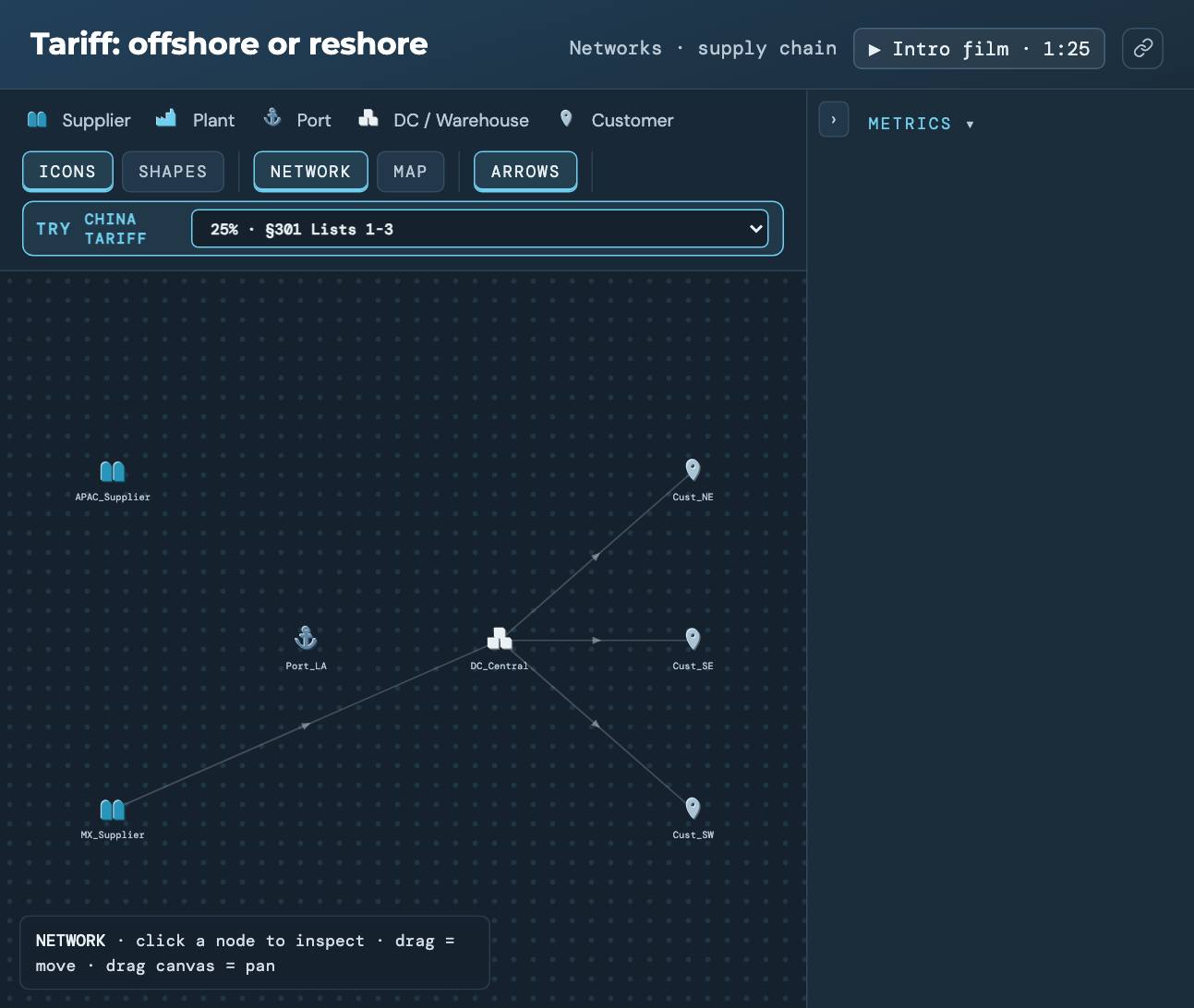
A supplier in China ships through the Port of Los Angeles. A supplier in Mexico costs more per unit but pays no duty. Step the China tariff and watch the optimizer choose.
The question it answers
At what duty rate does it stop making sense to buy offshore? A tariff is one more cost on a sourcing lane, so an optimizer weighs it with unit cost and freight. The point where the answer flips is the number a sourcing team needs before it signs anything.
What you’ll see
Both suppliers, the port, a central DC and three customer regions. The tariff control offers the China rates in US policy as of May 2026: 0%, 7.5%, 25%, 50% and 100%. Each option is a saved run of the AMOS optimizer. At 0% and 7.5% the optimizer buys from China. From 25% up it moves all of the sourcing to Mexico.
What to change
- Step the China tariff and watch the flows move between suppliers.
- Open the results column to see each run’s flows.
- Ask the assistant about lead time, or why Mexico rather than a US plant.
Where it leads
Tariff network redesign covers the full method: re-optimize under the new rates, then simulate the new network before any capital moves. The coffee co-pack demo asks the same kind of question about diesel.
Run Tariff: offshore or reshore
It opens in the Sandbox with sample data. No signup, no install.
Run it →Or see all eleven network demos.