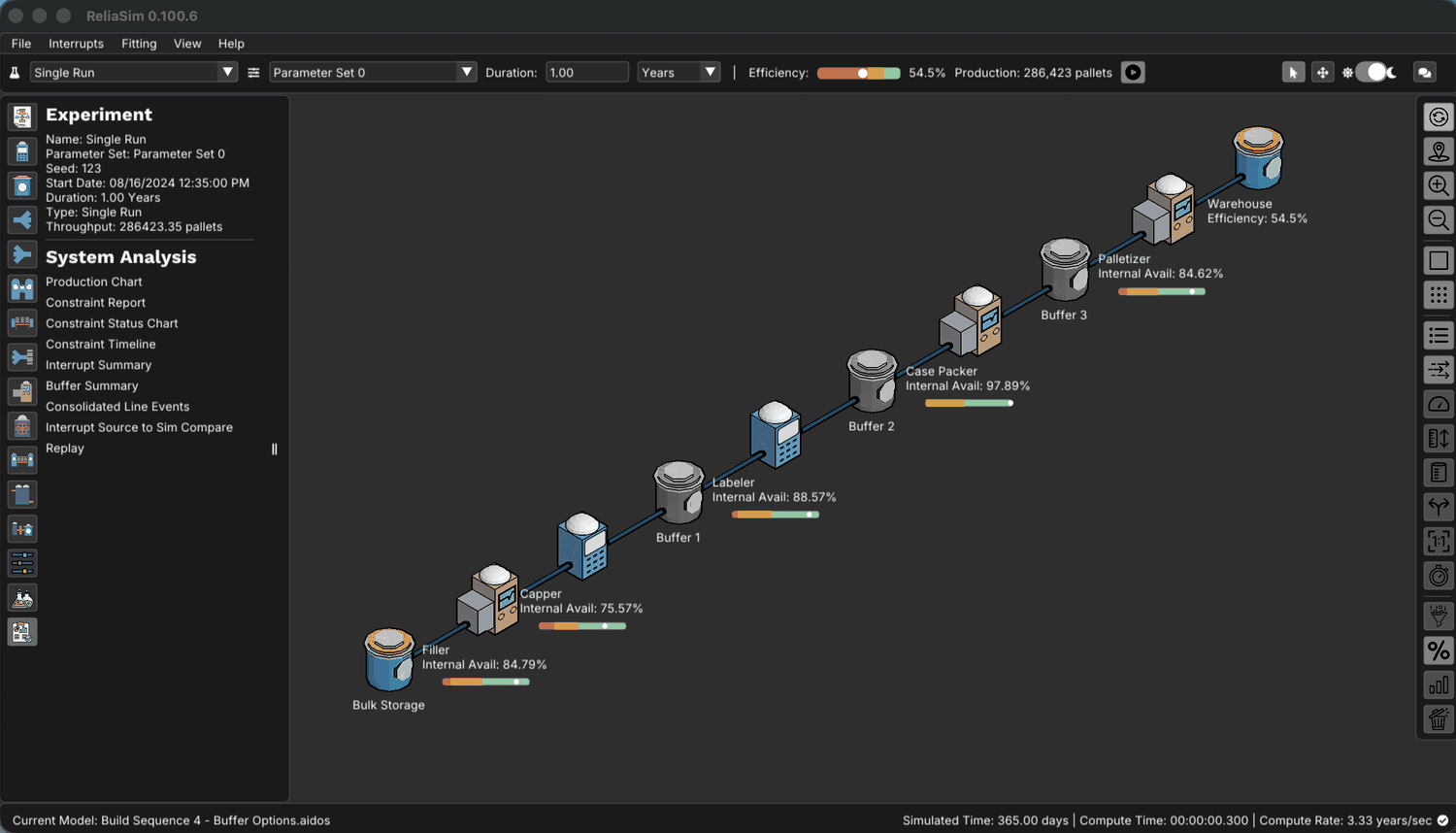
ReliaSim ships with the modeling team built in. No simulation department required — validated within 1% of measured OEE.
Confident choices, better outcomes.
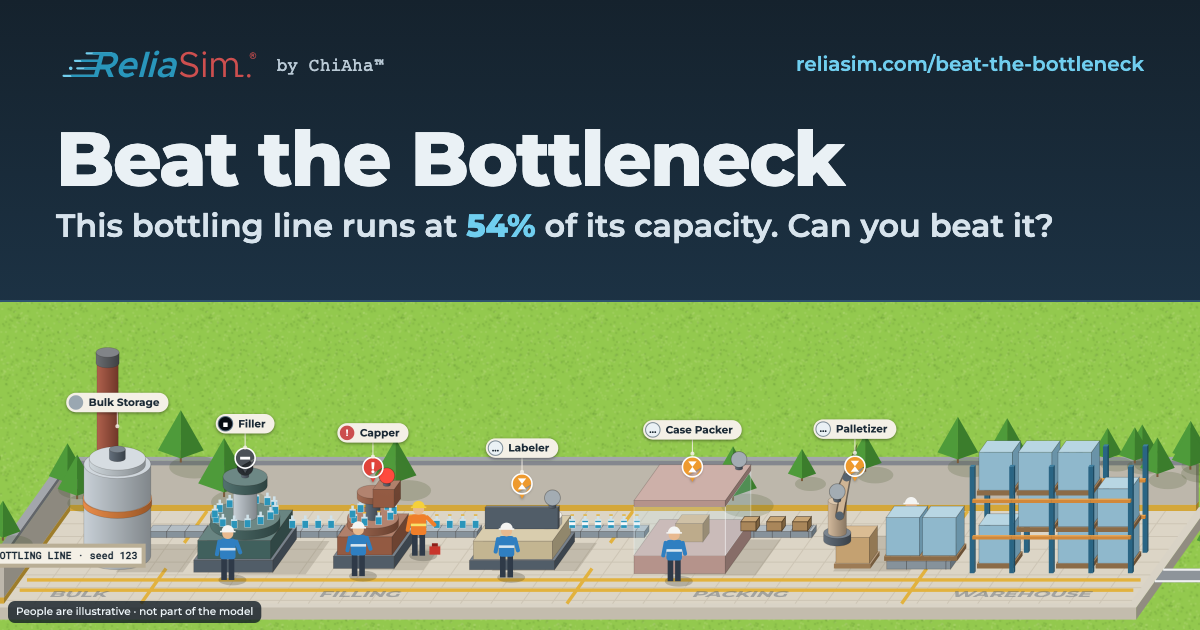
A browser-based explainer: 8 curated models from the same real bottling line, arranged across two tracks (Constraint-Level rollups vs LEDS-Level drill-downs) and four complexity steps. Numbers come from live dys-cli engine runs — no fabrication. Free to explore.
Capper_Upper Plow Area dominates at 20%.Consider two failure modes with identical total downtime per week. Your historian treats them the same. Your Loss Tree puts them in the same priority tier. But eliminating them produces completely different system-level results — because cascading losses never appear under the original failure's name.
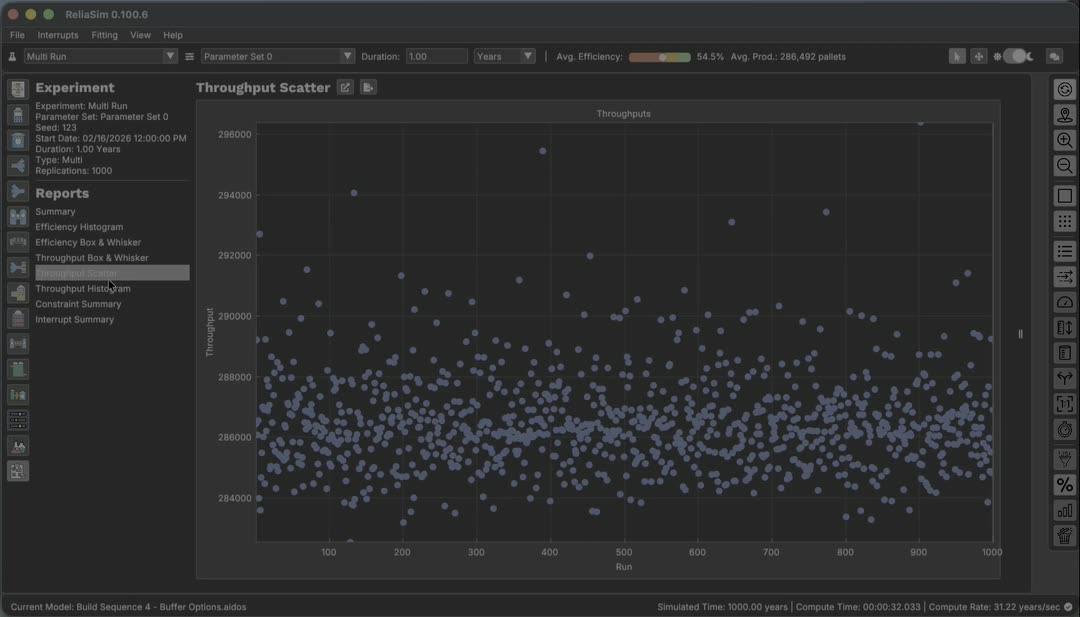
Flow-based simulation. ReliaSim models the continuous flow of material — pounds per hour, bottles per minute, the way operators actually think — and overlays every event onto that flow: every short stop, every restart, every blocked station, every starved buffer. Cascading losses emerge in the math, not in averages. The engine is fast enough to run a thousand year-long scenarios in under a minute — fast enough to test every fix you're considering, and statistically valid enough to bet capital on the answer.
ReliaSim exposes your production model through a Model Context Protocol (MCP) server. Claude and other MCP-compatible assistants can load, inspect, simulate, and interrogate the model in plain language. You drive the conversation; the model does the math.
Node types, buffer positions, interrupt configs, constraint availability — in plain language.
Per-constraint availability, OEE, and multi-run stats instantly.
Utilization, inflow/outflow, empty/full percentages, and throughput distributions.
Topology visuals and detailed exports — all from one conversation.
Responses powered by your specific validated production graph — not a generic AI.
Most sim tools hand you a blank canvas. ReliaSim hands you our method — the same sequence of checks, builds, and scenarios we'd run ourselves, guided end to end by AI that knows what good looks like.
Drop in your line event CSV. The system checks for gaps, time resolution, and fault-code hygiene before you build anything. Bad data caught before it becomes a bad model.
You don't need to know which distribution fits which interrupt type — the method does. Typical build: 15 minutes.
Fix priority, line speed, buffer sizing, redundancy, resupply — as structured scenarios, not blank-slate guesswork. See the five →
Every scenario run comes with the topology, the assumptions, and the sensitivity check a capital review needs.
This is what we mean by “the modeling team, built in.” The software isn't the product. The expertise is — and it runs every time.
ReliaSim is desktop-native by design. In a market rushing to move everything to the cloud, we built ReliaSim for the reality of modern manufacturing: segmented networks, isolated OT environments, and IP that should never have left the plant in the first place.
No SaaS vendor approval. No security review queue. No waiting on IT to greenlight a new cloud service. Download the installer, open your model, simulate in minutes.
Runs entirely on the user's machine, inside your firewall. No cloud uploads, no third-party data processor agreements, no exfiltration risk. Operates in physically or logically isolated networks — only license and version checks touch the internet, and even those can be deferred.
Your simulation models encode proprietary process knowledge — that's trade-secret territory. Keeping it local removes an entire class of vendor risk and shortens compliance review. Friendly to ITAR-, CMMC-, and GxP-bound deployments.
Three ways to answer production questions. Only one is validated within 1% of your actual OEE.
That's why Claude uses ReliaSim — instead of guessing.
These aren't hypothetical — they're the capital and operational questions that determine whether your next investment pays off or falls flat.
Predictable wear-out? Only 2–4% of downtime on a high-speed line. The other 95% of events aren't predictable before they happen — like bathroom stops and traffic jams on a road trip. You can't schedule around them. You have to design around them. These five decisions are how.
3D digital twins look like your line — and can take 6–8 hours to run a single scenario. That's face validity. For strategic capital decisions you need statistical validity: a model proven within 1% of your actual OEE, fast enough to run a thousand what-ifs before lunch. These five decisions require the latter.
With Tom Lange & Andrew Siprelle.
"Those 120 one-minute interruptions are creating cascading problems throughout your system that don't show up under the original problem's name. When you eliminate them, you often recover 180–220 minutes of uptime — significantly more than the original downtime suggests. The only way to predict this accurately is through simulation."
Three ways to start — explore on your own, see it live, or scope your system.
"It runs on my desktop. No integration, no IT project, no waiting. I just install it and start modeling."— Engineering Leader, Essity
No. After install and license activation, ReliaSim runs entirely offline. The application makes no outbound calls to load data, run simulations, or persist results. Periodic license and version checks occur over HTTPS when a connection is available; these can be deferred for air-gapped deployments.
Yes. ReliaSim is compatible with air-gapped (physically or logically isolated) networks, including OT segments, defense facilities, and validated GxP environments. Offline licensing is available for installations that never touch the internet.
On the user's machine, in locations the user controls. Models, input data (CSV / historian extracts), and simulation results are read from and written to local files. ReliaSim has no cloud datastore, no telemetry of model contents, and no third-party data processor.
No — and that is deliberate. Manufacturing process knowledge is trade-secret IP, and the operating environment of our buyers is segmented networks. We will not ship a SaaS version that compromises that. Need to share results across a team? You share files, not data exposure.
The MCP server is local. It exposes your model to whichever AI assistant you point at it — and you control that choice. If you connect to a hosted assistant, the data your assistant sees is governed by that assistant's policy. If you connect to a local model, nothing leaves the machine. The choice is yours, not ours.
Product updates, case studies, and fresh insights — straight to your inbox. No spam.