What it does
A ReliaSim model is built from your line’s own stop history and checked against what the line actually produced. ReliaSim Edge keeps that model connected to the line after it’s built. It reads the PLCs, stores the data on the plant floor, and passes it to the model, so the model sees what the line is doing now.
That’s useful when a decision is made shift to shift or hour to hour: what’s down right now, what’s sitting in the buffers, and which stop is worth fixing first today. For design and capital questions, the same model still runs on months of history. Digital twin vs simulation covers when a live connection is worth it.
How it works
- We ship the box. An industrial box PC arrives set up with the full stack. It starts on boot and recovers from power loss on its own.
- Plug it into your PLC. Wired Ethernet to the PLC on an isolated subnet, then power. No Windows licensing and no IT project.
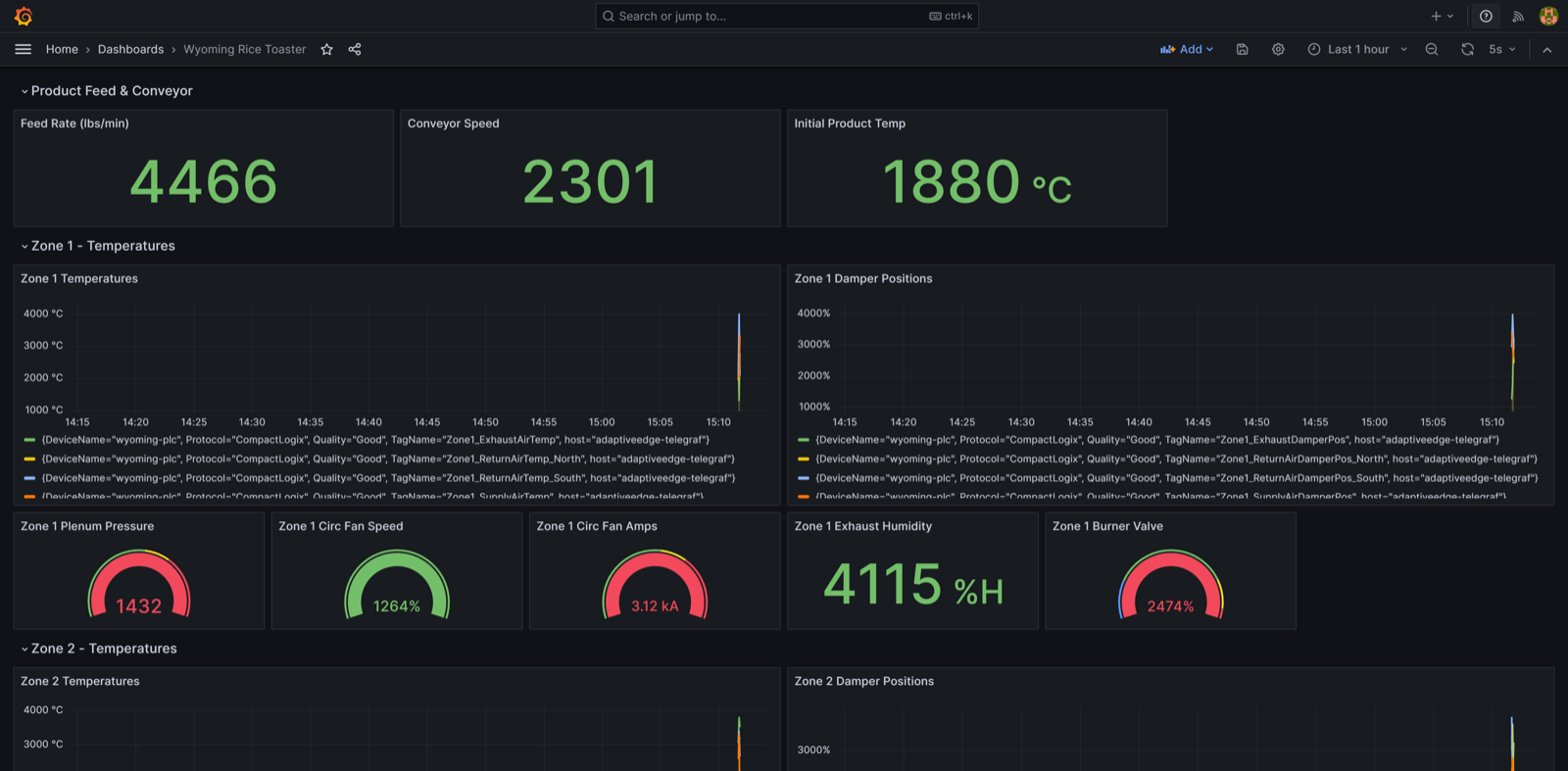
- Data flows in hours. Every tag is checked before polling starts, so nothing fails silently. Readings land in a local time-series database and show up on dashboards served from the box.
- The model runs beside the data. The line’s stops feed your ReliaSim model, and its results go to Grafana and your MQTT broker.
Where the live connection earns its keep
- A model that stays in step. Real stop events keep the model matched to the line as it runs, instead of to last quarter’s averages.
- Live results on the dashboards you already use. Expected against actual throughput and the stops costing the most today, published to Grafana, Node-RED or anything that reads MQTT.
- The stop log, captured cleanly. The same data becomes the time-to-failure and time-to-repair distributions a model needs. ReliaStats fits them.
- Write-back when you want it. The box can write values back to PLC tags, with each write confirmed.
Talks to what’s already on your floor
Protocols
| Protocol | Typical use | Status |
|---|---|---|
| EtherNet/IP | Allen-Bradley (CIP) | In production |
| Modbus TCP | Most PLCs and meters | Tested |
| MQTT | Subscribe to an existing broker, or publish results downstream | Tested |
| OPC UA | Newer PLCs | In progress |
Reads take under 100 ms, on a one-second poll by default. The local database keeps 7 to 30 days of data at about 10:1 compression.
Your data stays on your network
- Air-gap capable. Wired Ethernet to the PLC on an isolated subnet, and optional WiFi for remote maintenance. It works fully offline.
- No vendor tunnel. No outbound connections are required and there’s no broker in somebody else’s cloud. PLC to database to dashboard, all local.
- Your historian, on your hardware. Retention is yours to set.
Security and deployment has the details for IT reviewers.
Running on a plant floor today
The first field unit reads an Allen-Bradley CompactLogix: 32 active tags on a one-second poll, each read under 10 ms, with write-back to 6 PLC tags confirmed. It has been collecting production data on the floor since it was installed.
Frequently asked questions
Is ReliaSim live-connected?
Yes. ReliaSim Edge connects a ReliaSim model to your PLCs and MQTT broker, and the live connection is ready to deploy on your systems.
What do I need on site?
A PLC and an Ethernet port. We bring the box, set up with the full stack.
Does any data leave the plant?
No. The box stores data locally and needs no outbound connection. Results go only to the dashboards and brokers you point it at.
Which PLCs does it work with?
Allen-Bradley over EtherNet/IP is in production use. Modbus TCP and MQTT are tested, and OPC UA is in progress.
Do I need a live connection to use ReliaSim?
No. Most design and capital questions are answered by a model built from your line’s stop history. The live connection adds the current state for decisions made during the shift.
Connect a model to your line
We’ll ship a box to your site, connect it to your PLC, and have data flowing within hours.
Talk to us about a pilot →Not sure where to start? A free line assessment looks at your line first.