A Flight Simulator for Your Plant
Training on a Playing Field Built From Your Own Line
Pilots don’t learn what to do after an engine failure by waiting for one. They practice in a simulator until the right response is a habit. Most plants still train the other way, so people learn what a stopped capper does to the rest of the line by watching it happen, one expensive shift at a time. A model of your own line lets your team try a move, watch what the line does over the next 90 days, and try again, all before anything changes on the floor.
Why plants need practice, not only procedures
Standard work tells people what to do when a machine stops. It doesn’t teach them how the line behaves: how a stop on one machine spreads, which storage covers it and for how long, or why the machine with the most downtime isn’t always the one to fix. That understanding usually takes years on the floor, and a lot of it leaves when experienced people retire.
It’s also where good people guess wrong, in the same few ways in plant after plant. Three examples from our demo models:
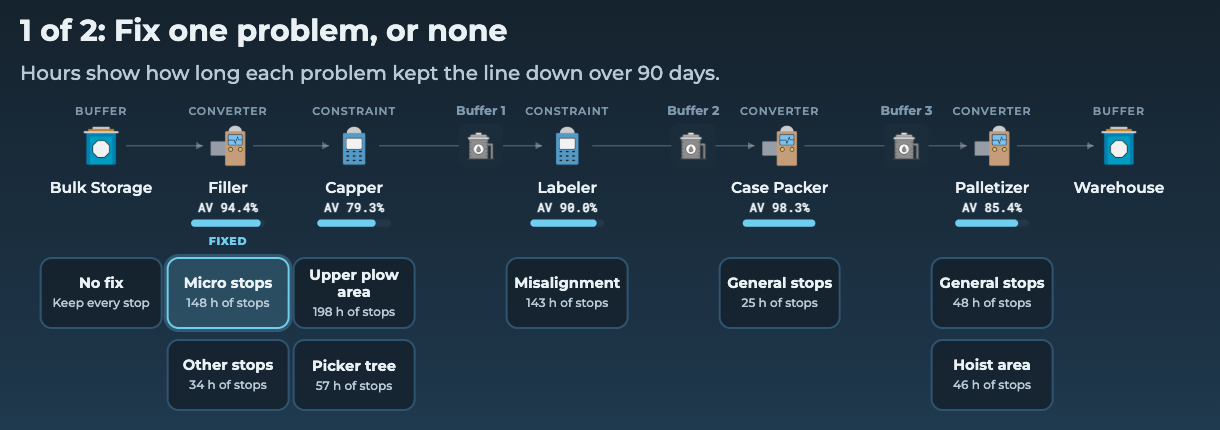
- “Fix the biggest bar.” On our demo bottling line, the Capper’s upper plow area is the biggest single problem on the constraint, at 198 hours down over 90 days. Removing it takes the line from 54.3% to 61.5%. Removing the Filler’s micro stops, at 148 hours, takes it to 62.1%.
- “More storage will fix it.” On the demo vegetable plant, cutting making runs from 24 hours to 12 locks up the bins. Doubling the bin size still leaves the plant stuck for 571 minutes. Timing the making runs to packing gets it to zero.
- “Buffer is buffer.” Put the same twelve slots of buffer on the bottling line in the best spots and it makes 88,227 pallets in 90 days. Put them in the worst spots and it makes 81,255.
None of these is hard to understand once you’ve seen it happen. A simulator lets people see it happen without losing a shift.
What a playing field is
We call the model a playing field. It covers the scope you choose, a line or a whole plant, built from your own data, and you play moves out on it before making them for real. It isn’t a live copy of the plant. It’s somewhere to practice.
For training, the playing field has to be right before anyone practices on it, because people learn whatever the model teaches them, mistakes included. So a training model gets the same check as a study model. It’s built from your own stop records, one failure mode at a time, and it has to reproduce what the line actually measured before anyone uses it. Our published validation model lands within 1% of the plant’s measured OEE (the case study).
What people practice on it
How variation adds up: the dice round
Before the model, the mechanism. Everyone gets a blue and a red 20-sided die. The blue die is the time until the next stop, and the red one is how long the stop lasts. Both come from a real machine’s stop log: line the run times up from shortest to longest, and the die picks a spot in the line. Roll them through a four-hour shift and the group sees that no two shifts come out the same, and that the “average machine” isn’t a machine anyone has ever run. It takes ten minutes, and nobody needs a statistics background.
What to fix first
Pick one failure mode, take it away in the model, run the line and read what comes back. Then try another. Operators and maintenance planners learn to rank fixes by what the line gets back, not by the hours on the downtime report. Which loss to fix first covers the method.
Where storage goes
Place a fixed amount of buffer and run the line. Move it and run it again. People see why storage that protects the constraint pays and storage in the wrong spot does very little. How big should a buffer be? runs the full sweep.
The shift ahead
Planners run the next shift’s plan on the model and look for trouble: a packing line about to run dry, a bin about to fill, a changeover landing at the wrong time. If they find it, they change the plan before the shift starts. One cereal plant runs its model before every shift.
Run lengths, changeovers and new products
Try a different run sequence, a shorter campaign or a new package size, and see what it does to the rest of the plant before the schedule goes out. The bin lock question in the Sandbox shows one schedule change on a demo vegetable plant.
What changes on the floor
When the model shows operators how their own stops move the whole line, the way they work changes. At a salad dressing plant, the plant’s engineering team reports that operators who saw this on screen became more vigilant and took more ownership of the improvements. Some of the best fixes needed no capital at all, only closer attention from the operators to two failure modes on the labeler. The details are in the salad dressing case study.
The same goes for new supervisors. Someone who has run the line through a bad week on the model has a feel for it that usually takes years on the floor.
Build a game on your own line. Beat the Bottleneck is our demo of the format: fix one problem, place twelve slots of buffer, and ReliaSim runs the line for 90 days, ten times over, with a shared leaderboard. The same format works inside a plant, with your machines, your stop records and a leaderboard for your shifts or sites. Play Beat the Bottleneck →
What a build includes
- Your stop log, turned into failure modes for each machine and fitted with ReliaStats®.
- A model of the line or plant, checked against what it actually measured before anyone trains on it.
- The moves your people should practice, chosen with you: fixes, buffer, run lengths, staffing, changeovers.
- Engine runs behind every answer. Every result the game shows comes from a ReliaSim run of your model.
- Screens that run in a browser on a training-room TV, a laptop or a phone, plus a dice round for the classroom.
The playing field is an ordinary ReliaSim model, so it doesn’t end with the training. Your engineers can keep using it for their own studies, and we can teach them how.
Who builds it
We’ve been delivering training and building simulators for 35 years. Andy Siprelle wrote the original official ExtendSim training course, and Simulation Dynamics trained hundreds of simulation professionals through it. Today we teach a two-day course at the University of Tennessee’s Reliability & Maintainability Center that counts toward the RMIC® credential, along with one-hour online sessions on each part of the workflow (training). The method underneath, discrete rate simulation, comes from the same team, and ReliaSim is its third generation.
Frequently asked questions
What is a training simulator for a manufacturing plant?
It’s a model of your own line or plant that people can practice decisions on, such as what to fix, where to keep storage and how to run the schedule. They see the result over weeks of production in seconds, instead of learning it on the floor.
How is it different from a digital twin?
A digital twin is usually connected live to the plant. A training playing field doesn’t need a live feed. It needs to be validated, so that it behaves the way your line behaves.
Do people need to know simulation or statistics?
No. The game asks plant questions in plant terms, like which problem to fix and where to put storage, and answers in output. The dice round explains variation with two dice and a stop log.
What does it run on?
The game screens run in a web browser on a TV, laptop or phone. Building and changing the model itself uses the ReliaSim desktop software.
Can our engineers keep using the model afterwards?
Yes. The playing field is a ReliaSim model, so it carries on as a study model after the training is done.
Want a playing field for your plant?
Tell us about the line and who needs to learn it. We’ll show you what a game built on your own data would look like.
Schedule a call → Play Beat the Bottleneck Training courses