Discrete Rate vs Discrete Event Simulation
Same Family, Different Answers on a Fast Line
Both methods are event-driven. They differ in what counts as an event, and that decides how each one copes once a line runs faster than a few units a minute. Here’s what each does well, where each breaks down and how to choose.
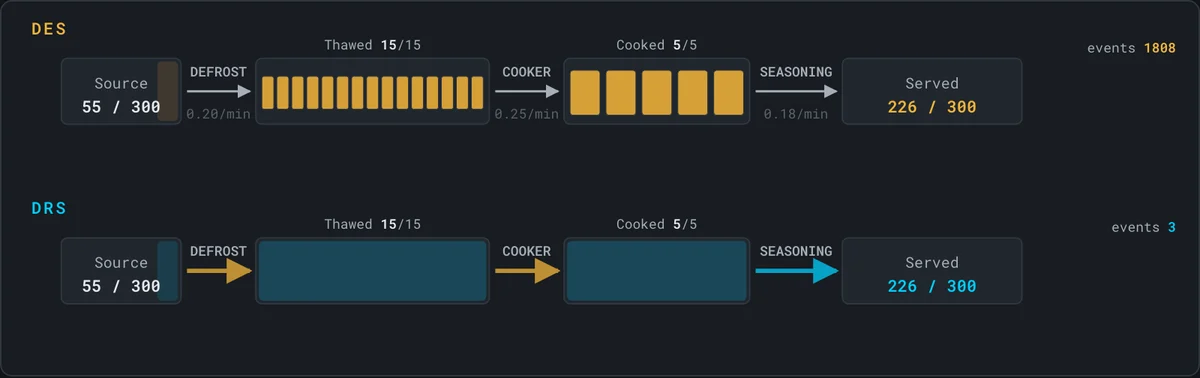
What counts as an event
Discrete event simulation (DES) models the system as a sequence of events involving individual entities. Each unit moving through the system is an event the simulator schedules, runs and cleans up, and the clock jumps from one event to the next.
Discrete rate simulation (DRS) models flow as a rate. Between rate-changing events such as failures, changeovers, blocking and starving, the rate is constant and buffer levels change linearly. The simulator does no work until something actually changes.
So in DES each unit is an event, and in DRS each rate change is an event while the units between events flow through as a continuous stream.
Side by side
| Aspect | Discrete event | Discrete rate |
|---|---|---|
| Unit of analysis | Each entity is an individual event | Flow is modeled as a rate |
| Computational cost | Grows with throughput. A faster line means more events and a longer run | Independent of throughput, with one event per rate change |
| Micro-stops | Often averaged into a single downtime factor | Each interrupt explicit, with its own TTF and TTR distributions |
| Blocking and starving | Approximated through entity-level events | Computed by flow propagation through the buffers |
| Buffer dynamics | Entities queueing and dequeueing | Levels change linearly between events, and fill and empty times are computed directly |
| Best fit | Low-volume systems, unit-level logistics, queueing networks where unit identity matters | High-speed lines, continuous-process manufacturing and bulk flow |
When discrete event is the right tool
Discrete event simulation is the right method whenever unit identity matters. That includes queueing networks where you care about specific customers and their waits, supply chain models that track individual orders, call centers where each interaction has its own attributes, and baggage handling where each bag routes through scanners and conveyors. Discrete rate adds a method for rate-based systems where DES struggles. It doesn’t replace DES.
Where discrete event struggles on high-speed lines
Computational cost grows with throughput
A bottling line running 1,200 cans a minute produces 1,200 events a minute per station in a DES model, so a six-station line produces about 7,200 events a minute. A shift produces millions, and real-line micro-stops such as three-second jams, label misreads and sensor faults add more. A model that takes overnight to run makes it hard to decide anything within days.
Knock-on effects get averaged away
The standard way out is to model at a coarser scale. Short stops get rolled into one downtime parameter, or the whole line is treated as one constraint with a reduced rate. That buys speed at the cost of the dynamics. You lose how a two-minute stop at station four shows up as starving at station two a little later, and those effects often decide real-line OEE.
Blocking and starving are approximated
DES handles blocking through entity logic. An entity finishes at one station, can’t enter the next and waits in a queue. The mechanics work, but the timing of how a stop spreads is approximated. Discrete rate computes blocking and starving by propagating flow through the buffer network.
The validation evidence
The 2020 Winter Simulation Conference paper High Accuracy Discrete Rate and Reliability Modeling to Drive Improvement of Plant OEE and Throughput (Fischel and Lange) reported a discrete rate model within 1% of a real food plant’s measured OEE. The paper’s co-author Tom Lange spent 36 years in manufacturing R&D, retiring as Director of Modeling & Simulation in Corporate R&D. See the published OEE validation case study.
Choosing between them
Use discrete event simulation when
- Individual identity matters, such as specific orders, customers or parts.
- Throughput is low enough that per-unit events are cheap to compute.
- You’re modeling queueing networks, call centers, baggage handling or dispatch.
- You need to track unit-level attributes through the system.
Use discrete rate simulation when
- Flow rate matters more than the identity of individual units.
- Lines run hundreds or thousands of units a minute, where DES becomes impractical.
- The process is continuous or bulk flow, such as chemicals, food and beverage, paper or pipelines.
- Knock-on effects from micro-stops drive performance, and buffer design and decoupling are central questions.
Which tools use which method
Simulation software is usually built around one primary method, even when it offers others. The table groups widely known tools by that primary method, using each vendor’s own description of its product. Most general-purpose packages are discrete event at their core, and several add flow, fluid or agent-based features. For discrete-part manufacturing, job shops, warehousing and material handling, a discrete event tool is usually the right choice. Discrete rate earns its place on high-speed and bulk-flow lines.
| Tool | Primary method | How the vendor describes it |
|---|---|---|
| Arena | Discrete event | “Discrete-Event, Flow, and Agent Based modeling methods” |
| FlexSim | Discrete event, with 3D visualization | “3D Simulation Modeling and Analysis Software” |
| Simul8 | Discrete event | “Simulation Software for Process Improvement” |
| Simio | Discrete event | “Discrete Event Simulation Software (DES)” |
| Siemens Tecnomatix Plant Simulation | Discrete event | “discrete-event simulation and throughput optimization” |
| ExtendSim® | Discrete event, discrete rate and reliability block diagrams (by edition) | “ExtendSim Pro for Discrete Event, Discrete Rate, & Reliability Block Diagramming” |
| AnyLogic | Multimethod: discrete event, agent-based, system dynamics | “the combination of system dynamics with agent-based and discrete-event methods” |
| ReliaSim® | Discrete rate, for production lines | “Manufacturing simulation software for high-speed lines” |
Vendor descriptions are quoted from each product’s own web pages as of September 2026. Product lines change, so check the vendor for current capabilities. ExtendSim® is a registered trademark of Andritz Inc. Arena, FlexSim, Simul8, Simio, Siemens Tecnomatix Plant Simulation and AnyLogic are trademarks of their respective owners, referenced for identification only, with no affiliation or endorsement implied.
What it looks like in code
The two methods make different choices about the simulator’s main loop. A DES simulator keeps a priority queue of events ordered by time. The main loop pops the next event, processes it (which may schedule more events) and advances the clock. Every unit transit is its own event.
A DRS simulator keeps the current rate of every flow, plus a queue of predicted rate changes. When will this buffer fill? When will this interrupt fire? When does the next changeover start? The main loop pops the next predicted event, recomputes the affected rates and buffer levels directly, and predicts the next event. Between events it does nothing, because rates are constant and buffers change linearly.
Frequently asked questions
Which simulation software uses discrete event and which uses discrete rate?
Most general-purpose simulation packages are discrete event at their core. Arena, FlexSim, Simul8, Simio and Siemens Tecnomatix Plant Simulation are all primarily discrete event tools, and some add flow, fluid or agent-based features. ExtendSim offers discrete event, discrete rate and reliability block diagramming, depending on the edition. AnyLogic is multimethod, combining discrete event, agent-based and system dynamics modeling. ReliaSim is a discrete rate simulator built for high-speed production lines. For discrete-part manufacturing, job shops and material handling, a discrete event tool is usually the right choice.
Count the events yourself
The Hamburger Duo runs one five-stage line as discrete event and discrete rate side by side, in your browser.
Open the Hamburger Duo →New to the method? Start with what discrete rate simulation is.