Consolidating a Soap Maker’s Plants Into One
The Model Catches a $4 Million Quality Problem First
A household-products manufacturer is moving its soap production from several plants into one facility that will make over 300 products. Its logistics manager needs to know whether the plan will work once demand, product mix, breakdowns and schedules all come into play. A simulation of the whole plant shows that the planned machine assignments would hold some products in the system too long and cause a quality problem. Other routings, tested in the model, avoid it and the $4 million retrofit it would need.
- The business
- A household-products manufacturer · soap plants consolidated into one, 300+ products
- The question
- Will the consolidated plant work, given how demand, mix and equipment vary over time?
- The model
- The whole plant, run from multi-stage production schedules
- What it is worth
- $4 million retrofit avoided; simulation required before major capital spending
- Source
- SDI project sheet
What the plant is up against
The company is collapsing manufacturing from multiple sites into a single optimized facility. Between them, the existing sites make over 300 different products, and the new plant has to absorb all of them.
Whether the plan is feasible depends on equipment design and sizing together with how the plant will be run. It also depends on conditions that change over time:
- Variable demand and seasonality
- Product mix
- Breakdowns and equipment variability
- Crewing patterns
- Product run sequencing
The logistics manager chooses simulation to see how these play out together and to understand the plant as a whole. It wins over other analysis tools because it captures real-world variability and the way events in one part of the plant affect another. A spreadsheet can size a machine, but it can’t show what happens when a seasonal peak, a changeover sequence and an unreliable upstream stage land in the same week.
How it is modeled
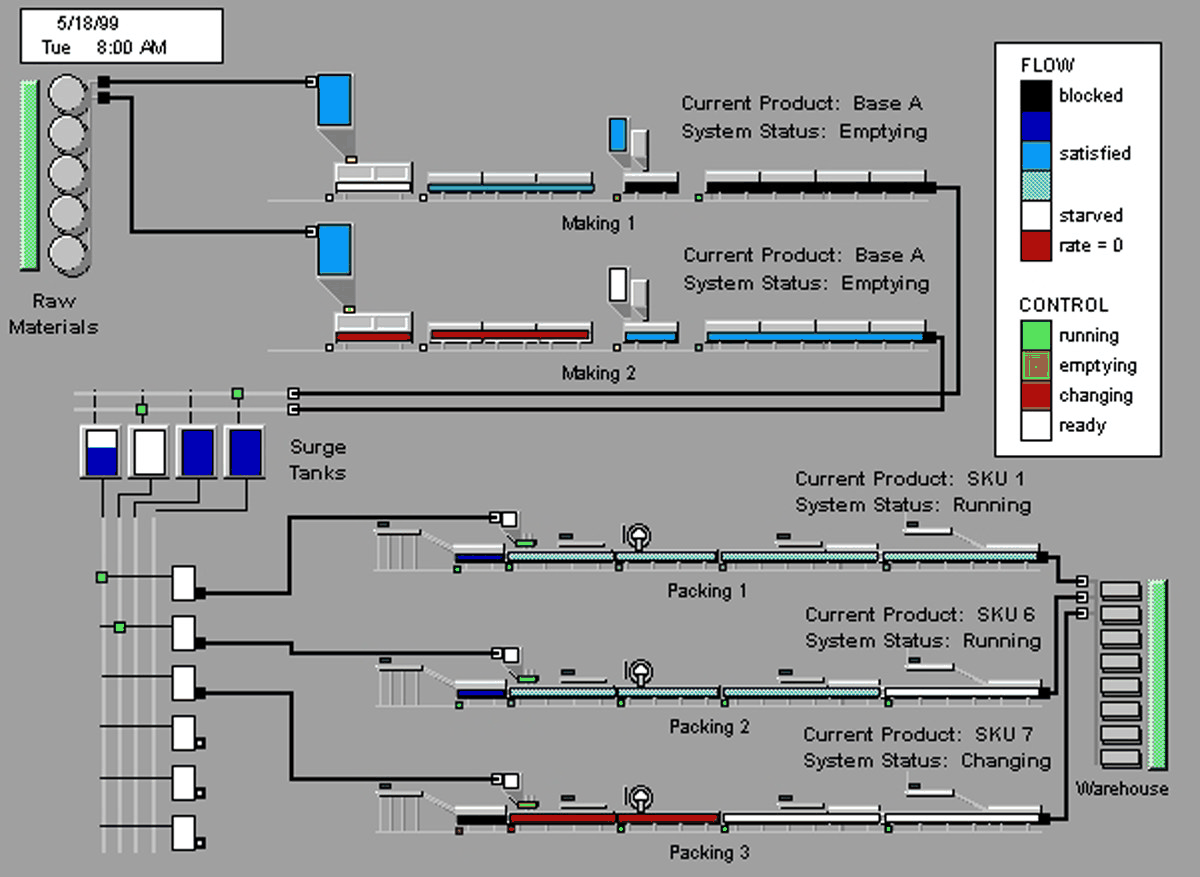
The manager partners with Simulation Dynamics (SDI) to build a model of the entire plant. It uses discrete rate technology, which is built for high-volume processes. An embedded database feeds the model the dynamic factors that affect throughput. Production schedules are defined in multiple sequential stages, and the model plays them out across every line.
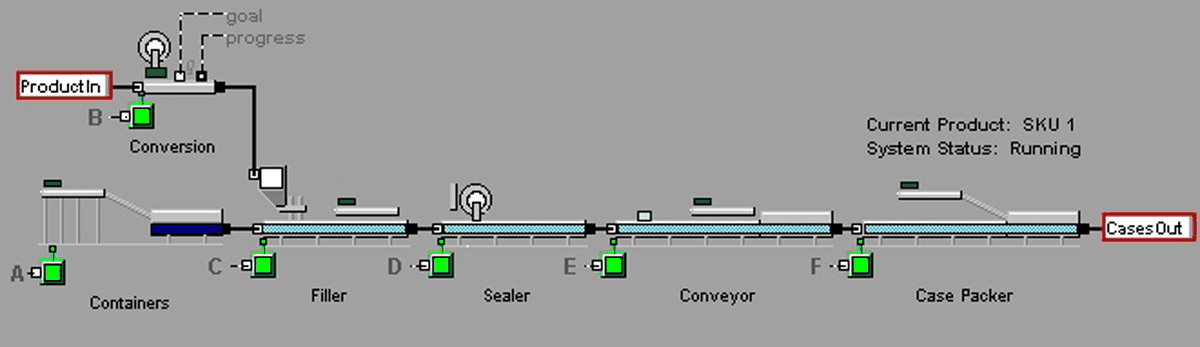
The plant view shows the status of all lines as the schedule ran: blocking and starving, changing over, emptying and surge. Each line opened into a more detailed sub-model nested inside it.
What the model shows
Running the model gives the team confidence in the consolidation strategy. It shows the balance of the plant and gives the optimal buffer size between processing and packaging.
The costliest finding is about time in system. For a given set of products, the planned machine assignments would leave material in the system too long, and for these products excess time in system means a quality problem.
One configuration shows severe long-term quality problems that would require a $4 million retrofit. The team tests other product routings and machine assignments in the model and shows how to avoid the problem, so the retrofit is never needed.
What changes
The project changes how the company spends capital. It requires a simulation study before committing to any major capital expenditure. The logistics manager then widens the simulation’s scope to the supply and distribution policies across the division.
Where this work comes from
The project is recorded in SDI’s project sheet, “Soap Manufacturer Saves Over $4 Million.”
Built by Simulation Dynamics, the team behind ReliaSim®, with the discrete-rate method ReliaSim is built on, an embedded database for the dynamic factors and multi-stage sequential schedules · source: SDI project sheet.
A free line assessment, this fall
Bring one question about your line. We model it on your own data and send back a two-page readout in about five business days.
Apply for a free line assessment →Or explore the Sandbox first, with no sign-up.